
Propylene Glycol Phenyl Ether (BG-PPH)
Propylene Glycol Phenyl Ether (BG-PPH)
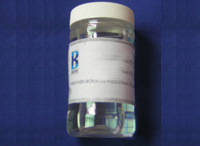
Chemical Name: Propylene Glycol Phenyl Ether
Structural Formula:
MolecularC6H5°CH2CH2CH2OH Weight:152.2
|
Properties |
Boiling Point ℃ |
Evaporation Rate |
Solubility |
Relative Density 25/25℃ |
PH Value |
Color |
Active Content % |
|
BG-PPh |
242.7 |
≤0.01 |
1.1 |
1.045-1.065 |
6±0.4 |
<150 |
≥99 |
BG-PPh is a colorless transparent liquid with a pleasant aromatic sweet odor. Its non-toxic and environmentally friendly properties significantly reduce the VOC content of coatings. As a highly efficient film-forming aid for various water-based latex and dispersion coatings, it is particularly effective in gloss and semi-gloss paints. It is a strong solvent for various polymers such as vinyl acetate, acrylates, and styrene-acrylate copolymers. Its low water solubility (lower than the evaporation rate of water, which helps swell particles) ensures complete absorption by latex particles, forming an excellent continuous film, thereby imparting the best coalescence and color development properties to latex paints, along with good storage stability. Compared with conventional film-forming aids such as TEXANOL (domestically known as alcohol ester-12), under conditions of complete film formation, equivalent gloss, flow, sag resistance, color development, and scrub resistance, BG-PPh usage is reduced by approximately 30-50%. With its extremely strong coalescing capability, overall film-forming efficiency is improved by 1.5-2 times, resulting in significantly lower production costs. For most emulsions, adding BG-PPh at 3.5-5% of the emulsion amount can achieve a minimum film-forming temperature (MFT) of -1℃.
Through product optimization, BG-PPh(E) and (T) can be added directly at any stage of paint manufacturing, greatly simplifying the process. This overcomes the stability issues associated with high-concentration use of this type of product in pure acrylic emulsions, special dispersions, or self-made emulsions.
Usage and Dosage:
1: We recommend adding BG-PPh before the emulsion or during the pigment grinding stage, which facilitates coupling with other components in the formulation, providing better emulsification and dispersion without affecting the stability of pigments, etc.
2: Generally, the dosage is 3.5-6% for pure acrylic emulsions, 2.5-4.5% for vinyl acetate-acrylic emulsions, and typically 2-4% for styrene-acrylic emulsions.
Packaging and Storage:
1: Available in 50 kg plastic-lined drums and 200 kg plastic-lined drums.
2: This product is classified as non-hazardous and should be stored in a cool, dry place.